  +86-515-88356562         info@aquachem.cn
Salt Test Strips vs Chlorine Test Strips: What Each Result Tells You
You are here: Home » Blogs » Salt Test Strips vs Chlorine Test Strips: What Each Result Tells You

Salt Test Strips vs Chlorine Test Strips: What Each Result Tells You

Views: 0     Author: Site Editor     Publish Time: 2026-11-09      Origin: Site

Inquire

facebook sharing button
twitter sharing button
line sharing button
wechat sharing button
linkedin sharing button
pinterest sharing button
whatsapp sharing button
kakao sharing button
snapchat sharing button
telegram sharing button
sharethis sharing button

Salt test strips report sodium chloride in pool or spa water, commonly expressed as ppm NaCl. Chlorine test strips report sanitizer readings such as free chlorine and total chlorine. A salt chlorine generator can use dissolved salt to produce chlorine, but that mechanism does not make a salt ppm reading the same thing as a chlorine ppm reading. Treat the two results as separate questions: is there enough salt available for the generator’s context, and is there measurable sanitizer in the water?

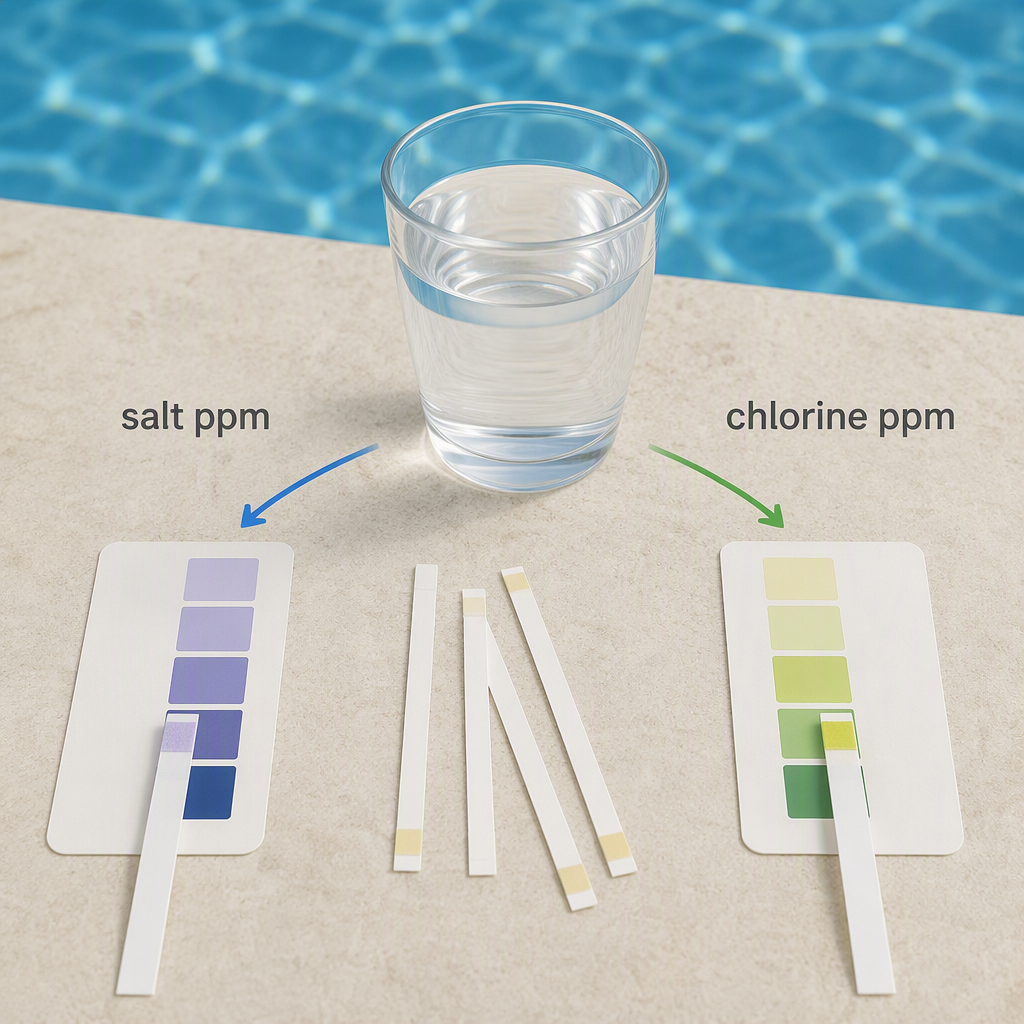
Pool water testing scene showing separate salt ppm and chlorine ppm result paths

Salt test strips vs chlorine test strips: what each result tells you

Use a salt test strip when the question is sodium chloride concentration, and use a chlorine test strip when the question is active or total sanitizer residual.

Salt test strip

One salt-strip product description states that the strip measures sodium chloride levels in saltwater pools and spas, with color-scale values listed at 0, 1000, 2000, 3000, 4000, and 5000 ppm NaCl.

For buyers, that makes the strip a supply-side check for saltwater systems, not a direct disinfection reading.

Chlorine test strip

One multi-parameter chlorine-strip product description states that the strip tests free chlorine, total chlorine, bromine, pH, total alkalinity, hardness, and cyanuric acid.

For maintenance teams, the chlorine pad answers whether sanitizer is being detected, while the other pads help screen broader water-balance questions.

Reader question Use salt test strips when... Use chlorine test strips when...
What is being measured? Sodium chloride concentration in ppm NaCl. Free chlorine and total chlorine, depending on the strip.
What decision does it support? Whether the salt side of a saltwater pool needs attention before interpreting generator behavior. Whether sanitizer is present and whether free and total chlorine results differ.
What it cannot answer alone It cannot directly confirm active chlorine residual. It cannot confirm sodium chloride concentration for a salt generator.

Why salt ppm does not equal chlorine ppm

Salt ppm and chlorine ppm describe different chemical checks, even in a pool where a generator uses salt to make chlorine.

Free chlorine vs total chlorine on a chlorine test strip

Free chlorine is the active chlorine available to disinfect water, while total chlorine is the sum of free chlorine and combined chlorine.

A chlorine-strip product description defines free chlorine as the active form available to disinfect water and total chlorine as the sum of free chlorine and combined chlorine.

That makes the free-versus-total split useful when a pool looks easy to explain from one number but is not. If free chlorine and total chlorine appear different, the strip is telling you more than a simple pass/fail sanitizer story. Pool retailers and service teams should train staff to read the pad labels carefully, because a total-chlorine number alone does not replace a free-chlorine reading for sanitizer availability.

How a salt chlorine generator changes the troubleshooting context

A salt chlorine generator adds equipment indicators to the decision, but those indicators should be read alongside, not instead of, separate salt and chlorine tests.

Decision sequence for conflicting salt and chlorine results

When salt, chlorine, and generator indicators disagree, separate the problem into measurement, sanitizer, equipment, and operating-condition checks instead of forcing one reading to overrule all the others.

Decision flow showing salt ppm, chlorine ppm, generator indicators, and retesting paths
Situation What the result can mean Next practical check
Salt strip shows sodium chloride in the expected general direction for the site’s generator context. Salt supply may not be the only reason sanitizer is low. Read free chlorine and total chlorine separately on an appropriate chlorine strip.
Free chlorine appears low while total chlorine is present. The sanitizer story may require more than a salt adjustment. Confirm the reading with a fresh strip, correct timing, and the pool operator’s accepted test method.
Generator indicators report salt, flow, cold-water, cell, or sanitizer-output status. The equipment may be giving a model-specific diagnostic clue. Compare the display with that generator’s manual rather than applying another model’s thresholds.
The pool uses a generator that converts dissolved salt into chlorine. Salt is part of the chlorine-production pathway, not the same measurement as chlorine residual. Retest both categories before adding product or changing equipment settings.
  1. Start with the question: are you checking salt concentration, sanitizer residual, or equipment status?
  2. Use salt test strips for sodium chloride ppm, and record the result in the same terms used by the pool’s generator documentation.
  3. Use chlorine test strips for free chlorine and total chlorine, and do not replace one result with the other.
  4. Check generator indicators only within the model family they belong to.
  5. Before opening powered equipment for access or inspection, switch off and disconnect the relevant power source, then follow the model manual’s permitted procedure.
  6. When the results still conflict, retest with fresh materials and escalate to the equipment supplier or qualified pool professional instead of guessing from one strip.

Why equipment guidance must stay model-specific

One salt-generator product page can help explain the kind of diagnostic information a generator may provide, but it should not be treated as a universal operating rule for every pool.

Do not confuse routine testing with draining or discharge checks

Draining a pool can require a different checklist from routine swimming-pool testing, especially where local stormwater or discharge rules apply.

The City of Norfolk pool-maintenance page distinguishes chlorinated and saltwater pool discharge considerations and advises using a pool testing kit before draining to confirm residual chlorine or bromine below 0.1 ppm, salt neutralized if applicable, and pH between 6.0 and 8.0.

This is a local environmental-discharge example, not a global routine pool-operation target. If you are preparing to drain water, check the applicable local authority’s rules and separate that task from ordinary day-to-day pool balancing. For the Norfolk example, see the city’s Pool Maintenance guidance.

Selection checklist for saltwater pool testing

For saltwater pools, keep testing available for both salt concentration and chlorine residual, because each answers a different operating question.

  • Choose salt test strips when the task is sodium chloride ppm in a saltwater pool or spa.
  • Choose chlorine test strips when the task is free chlorine, total chlorine, or related water-balance parameters shown on the strip.
  • For retail shelves, label the difference plainly so customers do not buy salt strips expecting a chlorine result.
  • For maintenance routes, record salt ppm and free-chlorine readings as separate fields, even when the pool uses a salt chlorine generator.
  • For troubleshooting, keep the generator make and model with the test log, because equipment indicators are model-specific.
  • For draining or discharge work, verify the local rule set before relying on routine pool-service habits.

Conclusion

Salt strips, chlorine strips, and salt-generator indicators work best when each is used for the question it is designed to answer.

Salt test strips measure sodium chloride concentration.

Chlorine test strips can report free chlorine and total chlorine.

A salt chlorine generator can convert dissolved salt into chlorine, but the salt result and chlorine result remain separate checks.

Generator indicators can add useful context within their own product model.

For conflicting results, retest methodically, keep the categories separate, and use the specific equipment manual before changing settings or opening equipment.

FAQs about salt test strips and chlorine test strips

These questions cover the most common points of confusion when saltwater pools show salt, chlorine, and generator readings that do not seem to match.

Do salt test strips measure chlorine?

No. The salt-strip example measures sodium chloride levels in saltwater pools and spas.

Use a chlorine test when the question is sanitizer residual.

Why use chlorine test strips in a saltwater pool?

A salt generator can use dissolved salt to produce chlorine.

A chlorine strip is still the tool category that reports free chlorine and total chlorine.

What is the difference between free chlorine and total chlorine?

Free chlorine is defined as the active form available to disinfect water, while total chlorine is the sum of free chlorine and combined chlorine.

If salt looks fine but chlorine is low, should I add more salt?

Not automatically. A salt result and a chlorine result answer different questions, so retest both categories and check the generator’s model-specific status before changing water chemistry.

Should I trust the generator display or the strip?

A generator display can provide model-specific clues such as salt, flow, cold-water, cell, or sanitizer-output status.

Use the display and strip as different inputs, then compare both with the exact generator manual.

What should pool retailers stock for saltwater customers?

Salt test strips support sodium chloride ppm checks.

Chlorine test strips support free-chlorine and total-chlorine checks.

Retailers should make the difference clear at the shelf and in staff guidance.

Are draining checks the same as routine pool testing?

No. The Norfolk discharge guidance treats residual disinfectant, salt if applicable, and pH as separate checks before draining.

Local discharge rules can differ, so check the applicable authority before draining water.

Over the past decade years, Aqua Chem have become one leading professional swimming pool & spa Chemical supplier and exporter in China.

Quick Links

Products Category

Get In Touch

  info@aquachem.cn
       xhhou@aquachem.cn
 +86-515-88356562
 +86-13805104650
+86-13770057055
+8613805104650
+8613770057055
Room 802, 12-1 Bldg, Green Land Business Centre, No.58 Xiwang Avenue, Yancheng, Jiangsu, China
Contact Us
Copyright   2025 AQUA CHEM INDUSTRY CO., LTD.  All rights reserved. Sitemap | Privacy Policy